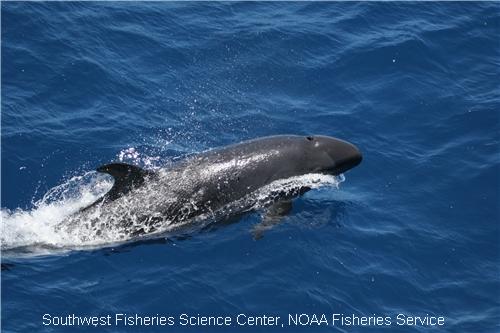
False Killer Whales
Pseudorca crassidens · Toothed whale
False killer whales are mammals and members of the dolphin family.
Classification
| Kingdom | Animalia |
| Phylum | Chordata |
| Class | Mammalia |
| Order | Cetacea |
| Family | Delphinidae |
| Genus | Pseudorca |
| Species | crassidens |
Size
Male false killer whales are larger than their female counterparts. Females reach 15 feet in length and weigh up to 2,600 lbs; males measure 20 feet and weigh up to 4,800 lbs.
Description
False killer whales have a small conical head without a beak and slender, streamlined bodies. They are dark gray to black with lighter shading on their underside.
Did You Know?
As the name implies, false killer whales share a number of characteristics with the orca, including preying on other cetaceans.
Habitat
False killer whales prefer tropical to temperate waters deeper than 3,300 feet, found in the Mediterranean Sea, Red Sea, Atlantic Ocean, Indian Ocean, Pacific Ocean, and off the coast of Hawaii.
Diet
False killer whales feed primarily on squid and large fish.
Communication
False killer whales use sounds for echolocation and to communicate with each other.
Reproduction & life span
False killer whales sexually mature around age 12 and give birth every 7 years, carrying their young for 14 to 16 months. Calves are 5.3–6.5 feet at birth and are weaned between 1.5–2 years. Average life span is 58–62 years.
Social structure
False killer whales are gregarious and highly social, forming strong social bonds. They are found in pods of 10–20 whales, and can also be part of much larger pods of 40–100 whales.